

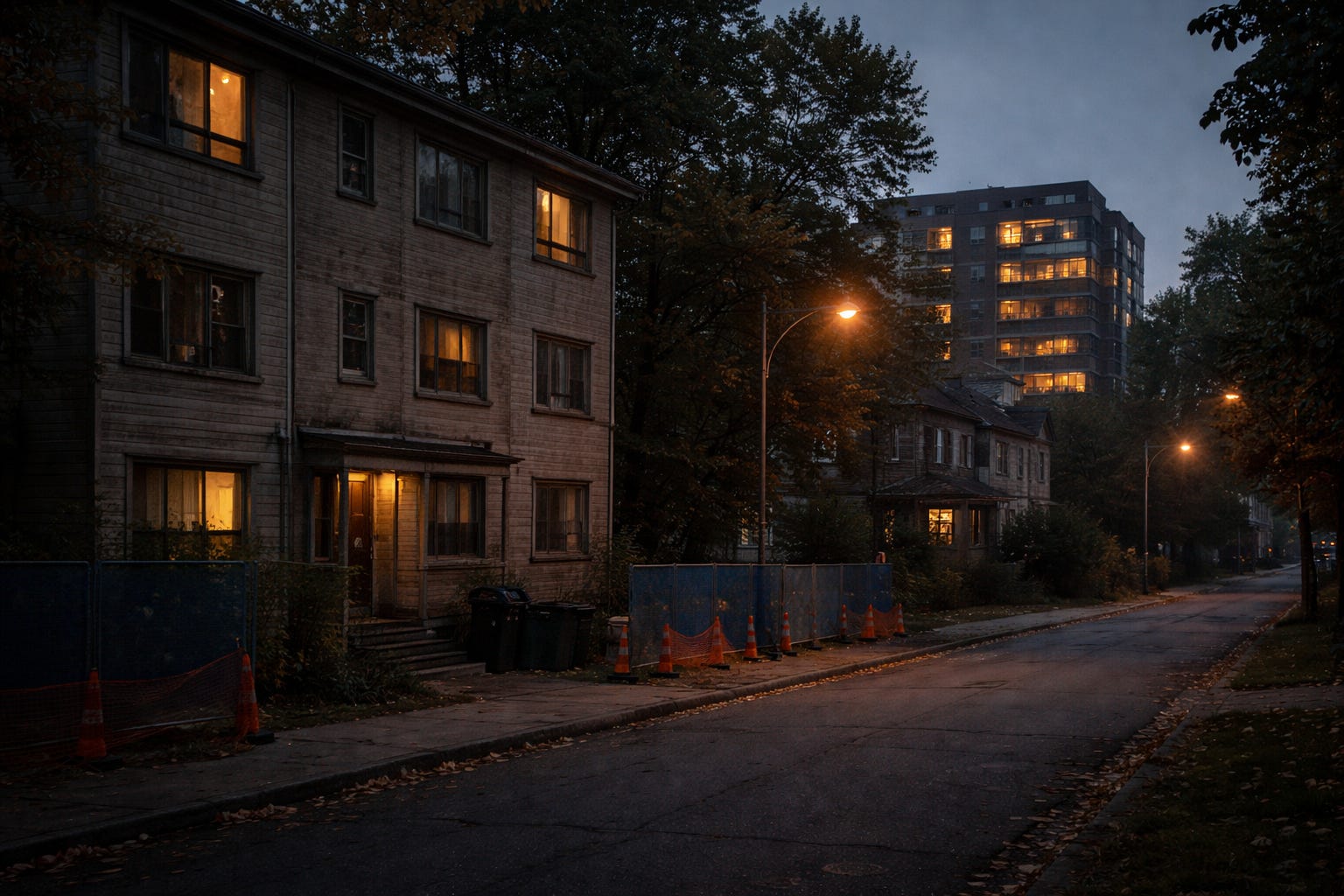
All three of them had received the letters twice. They arrived with polite margins, addressing the “Resident” when names no longer mattered. They thanked them for their cooperation before asking anything at all. One morning, the air carried dust from the construction nearby, fine enough to coat the windowsills. Fences went up, blue boards, orange mesh. Temporary structures that stayed. Buildings phased out. Lives relocated.
At night, the streetlights hummed like they were processing something.
People stopped sitting on their stoops.
No one said Thomas Reed.
No one had to.
Lena lived in a tiny apartment that existed because no one had bothered to correct it. The apartment complex had been divided and redivided until the hallway no longer knew where it led. Her door did not match the frame. Her rent was paid in increments that never added up. She moved lightly around her one hundred square foot studio, as if weight were something that could be negotiated.
She believed survival was personal. If she stayed agreeable enough, flexible enough, the world would not notice her as a problem.
She noticed him.
He got out of his new black Audi. Grey suit pressed, perfectly tailored. His black hair slicked back, grey highlighting his temples. A smaller man, dressed in typical managerial attire, with a clipboard addressed him. She watched as their heads turned her way, the manager pointing toward the building. Her shoulders instinctively curled inward; she pivoted away from the window. Looking down at the letter on her table, she read it again.
She exhaled.
It was from the property owner. It explained timelines, options. Lena had packed before she was told to. She folded her life into tiny bags that could be lifted without bending the knees.
She glanced at the old photo on the fridge, the one of an older woman with kind eyes and a house that looked like it had grown roots. Emergency contact, she thought, folding it into her purse.
When the inspector came, he did not see her.
She said once:
“I’m not really in the way.”
He nodded, because nodding was easy, and wrote nothing down.
***
The inspector arrived on Tuesday, which felt appropriate to Marcus. Not urgent enough to alarm, not casual enough to dismiss. He wore the same neutral expression, as if faces were standardized. He lived two houses down from Lena, on the twelfth floor. His building had a name. It promised community through glass walls and convenience. The lobby smelled faintly of eucalyptus—marketed as clean. A screen near the elevators scrolled announcements no one read anymore because they trusted it to be accurate.
Marcus believed in structure, plans, and order. He recycled correctly. He paid early. His girlfriend, Margo, had her manicures, Botox, and BMW— all paid for by Marcus. His life was a sequence of confirmations that he kept copies of.
He didn’t open the door right away.
“Routine review,” the inspector said, handing Marcus a letter already folded along its creases.
He nodded, because nodding meant cooperation, and cooperation had always worked.
Inside the unit, the glass made everything visible. The city watched itself reflected back, multiplied and softened. Marcus set the letter on the counter beside a neatly stacked folder labeled HOUSING-CURRENT.
When he read it, he read it for exclusions.
The language was familiar. Redevelopment incentive. Voluntary transition. Tenancy options. He underlined nothing. He made notes in the margins, small corrections someone would appreciate.
This does not apply to me, he thought.
His unit met code. His building had standards, and he followed all the instructions.
He emailed the contact at the bottom of the page, attaching documents before they were requested, and made sure to use bullet points.
The reply came two days later.
“Thank you for your inquiry.”
Marcus felt relief immediately. Gratitude was a language he understood.
This morning was sunny for October. He was drinking his espresso in front of his large bay window, soaking up the cool rays, when he noticed a car pull up.
A new black Audi.
The driver got out.
Opened the back passenger door. A tall, handsome man with slicked-back black hair and a grey tailored suit stepped out. His head immediately turned upward towards Marcus. Marcus was too high to see his expression, but his eyes narrowed, reading posture. He was exceptionally poised, and his shoulders straight and narrow—great posture, he thought. The man continued on, walking into the building. Marcus continued to sip his espresso carefully, holding on to the cup tighter. He noticed his palms were sweatier than usual.
Later that day, he scheduled a call. The voice was pleasant and unmemorable.
“Yes,” the voice said. “You’ve done everything right.”
Marcus smiled, because being right had always been sufficient.
“Of course,” the voice continued, “that’s precisely why this process should be smooth for you.”
He smiled wide as he took notes.
“This is just a matter of reclassification,” the voice said. “An upgrade, really.”
Marcus said, once:
“I followed all the guidelines.”
The voice agreed.
The inspector did not return. And neither did the tall man.
***
The inspector arrived with the same face Eleanor had seen in previous decades. He stood on the threshold and waited. She viewed him from the peephole.
The house was older than the paperwork. It had been added onto instead of replaced. Nails held beside screws. Repairs showed their age without apology. The walls bore the soft distortions of time, like a body that learned to carry weight.
Eleanor did not call it an asset.
She called it the house.
She knew where the floor dipped, which window rattled with wind. She saw the tree line disappear into a city, though it had been planted by someone who expected to stay.
The letter arrived folded too neatly.
She didn’t open it at first—not because she was afraid, but because she already knew its shape. The language had come before under other names.
Zoning.
Incentives.
Improvements.
She studied the inspector from behind the large oak door.
“This area is being reviewed,” he said.
She opened the door.
She nodded. Not in agreement; in recognition.
She had watched neighbors disappear one at a time, each with a reason that sounded reasonable. She had seen how the city preferred cooperation to conflict.
The inspector gestured toward the foundation, the acreage, the inefficiencies.
“You will be compensated generously,” he said. “Most people are relieved. I heard Mr. Reed is spending a fortune on this new development.”
Eleanor looked past him, at the house and the land.
She said only:
“Mr. Reed can’t take this. It was never for sale.”
The inspector’s eyes opened wide, body shifting to the left.
He did not argue.
He noted it.
The inspector left without slamming the door.
She noticed that.
Days later, she stood in the kitchen as the kettle went quiet, the house settling back into itself.
The phone rang once. Then again.
She answered.
“You’re listed as the emergency contact,” the woman said.
“Yes,” Eleanor replied.
Hours later, a knock came at the door just before dark. Eleanor opened it smiling. She ushered Lena in quickly out of the cold, the heavy door locking behind her. Lena carried a few small bags that had lost their shape. Eleanor set a cup of hot cocoa on the kitchen table without asking.
Lena took the hot mug into her red hands, pressing it gently to her lips, the steam warming her face.
“I won’t stay long,” Lena murmured into her cup. “I just need to crash a few days until I find a place, then I’ll be on my way.”
“You’re welcome here. Stay as long as you need,” Eleanor said, grabbing her own cup.
The two stared at each other. Lena adjusted in her chair. Eleanor’s eyes moved around the room. Lena’s gaze also shifted, looking at the worn yellow wallpaper whose flowers had long faded into faint outlines, the warm oak beams, the glass windows that slightly blurred, countertops that were shorter. The room smelled stronger than the cocoa—of musk.
A week later, Marcus arrived after dark.
Eleanor heard the gate before the knock. Then the knock waited.
She looked through the door’s peephole.
He stood with one suitcase and a laptop case slung too carefully over his shoulder. He had not shaved. His clothes were pressed, but had slight creases in unexpected places, and his shoes were clean in a way that was still polished.
Then the knock.
She opened the door.
“I won’t be long,” he said, immediately.
Eleanor stepped aside.
He placed the suitcase near the wall and left it closed. He didn’t say much. He asked where the outlet was. If the chair was all right.
Later, after the house had gone to sleep, Eleanor noticed a folder on the coffee table—letters stamped FINAL, NOTICE, RENUNCIATION—words that had meant safety.
The letter came weeks later.
Eleanor read it standing at the sink. It said very little, but enough.
The claim had been withdrawn. No further action would be taken.
She folded the paper from her lawyer twice and placed it beneath the others.
Marcus was at the table, repairing a hinge that didn’t need repair. Lena slept on the couch, her shoes still on.
Outside, the machines moved farther down the street.
Eleanor went to the front room. The light was slowly fading into night as the house held steady.
If you enjoyed reading, you can buy me a coffee ☕ — a small gesture that helps keep the creative fire burning.
If this piece spoke to you, tap the ❤️ or share it with someone who might need it too. Your quiet support keeps the ink flowing.
Nice work on this one! Definitely enjoyed.
That was a remarkable transition from character to character. Then with them all coming together at the end, it was a very beautiful choice!
I quite enjoyed this short story! Well done, Rose! 😊