

A note on this series
I’ve been studying the neuroscience of love, and these essays are my way of thinking alongside what I’m learning.
They are not formal lectures or scientific explanations, but reflections: one idea at a time, filtered through psychology, philosophy, literature, and lived experience. I’m less interested in reducing love to chemistry than in asking what the chemistry reveals about being human.
This is a notebook of synthesis: part study, part reflection, part attempt to understand why love continues to shape our attention, our bodies, our choices, and our search for meaning.
If you missed the previous article: The “Us” Circuit, you can read it here.
Attraction Before Explanation
Sometimes attraction happens before you have a decent explanation for it.
You notice someone, and it is not even that dramatic at first. Maybe it is their voice. Maybe it is the way they move through a room. Maybe it is their face, or their laugh, or some very small thing you would sound ridiculous trying to explain later.
Nothing has happened, technically.
But the body has already registered something.
I think this is one of the strange things about attraction. We often talk about it as if it is a conscious preference. As if we are walking around with a neat little list: kind, funny, intelligent, attractive, emotionally stable, likes books, doesn’t text like a hostage negotiator.
And yes, those things matter.
But before the list, there is the body.
There is the eye taking in shape, movement, symmetry, expression. There is the brain recognizing a face, comparing it to memory, deciding whether something feels familiar or interesting or alive. There is the body-image system doing its own quiet matching. There are emotional centers responding before we have language for the response. There is dopamine, that little flare of anticipation. There is the insula tracking the inner state of the body: the quickened heart, the warmth, the tension, the gut feeling, the subtle lean toward or away.
That part really interests me.
Because it means attraction is not just “out there” in the other person. It is also happening in here, in the body’s interpretation of them.
How do I feel when I see them?
Does my attention sharpen?
Do I feel curious?
Do I soften?
Do I get nervous?
Do I want to look again?
And then, because human beings cannot leave anything alone, the mind starts explaining.
Maybe they are my type. Maybe they seem kind. Maybe they remind me of someone. Maybe they have “good energy,” which is sometimes just our very modern way of saying: my body reacted and I am trying to sound less embarrassing about it.
What I’m learning is that the brain builds attraction in layers. First there is perception: face, body, movement, voice. Then sensation: what the body feels in response. Then memory: who does this remind me of, what old template is being activated, what story has my nervous system seen before? Then reward: dopamine makes the person feel interesting, possible, worth noticing. And only after all of that do we often get the conscious explanation.
So sometimes we do not first decide someone is attractive.
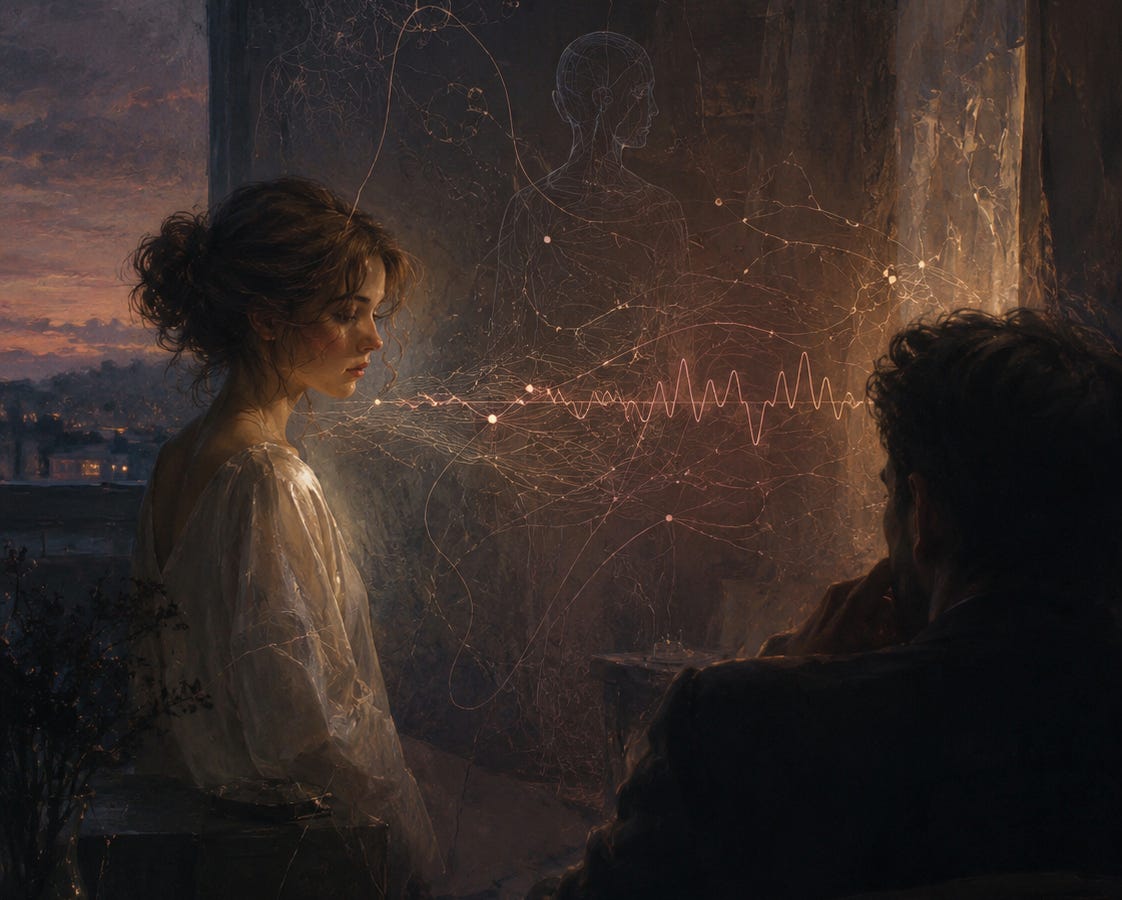
We feel something, and then consciousness begins writing the caption.
That does not mean attraction is always wise. The body can be brilliant, but it can also be deeply unserious. It can respond to old wounds, old fantasies, old patterns, or someone who simply knows how to create a little mystery. It can confuse familiarity with safety. It can confuse intensity with meaning. It can confuse “I recognize this” with “this is good for me.”
Still, I don’t think that makes attraction shallow.
It makes it worth paying attention to.
Not obeying blindly. Not dismissing either. Just noticing.
What did my body register before I had words?
What story did my mind start building around that signal?
And am I actually seeing the person in front of me, or am I already falling for the explanation I made after the feeling arrived?
The Body Has a Picture of Itself
One idea that keeps me thinking is that the brain does not only see bodies out in the world. It also carries a picture of the body from the inside.
Not a literal picture, exactly. More like a map. A felt sense of shape, boundary, ownership, proportion. This is part of how I know my hand is my hand, my face is my face, my body is mine. Most of the time, we never think about this because the system works quietly. It gives us the ordinary feeling of being located inside ourselves.
But when that map is disrupted, things can become strange. A person may feel that a limb does not belong to them. The body is physically there, but the brain has not fully claimed it as “me.” This is connected to regions involved in body image and selfhood, especially the superior parietal lobule, which helps create that sense of bodily ownership and form.
What really interests me is the possibility that attraction begins, at least partly, from this same hidden place.
Beneath romance, personality, and all the reasons we give later, there may be a very basic bodily recognition happening.
This is a body.
This is human.
This has a shape I can register.
This feels familiar, or compelling, or somehow right.
That sounds almost too simple, but maybe it matters. Because attraction is not only about the other person’s body. It is also about our own body’s sense of what a body is. The person we notice has to pass through this internal map, this quiet system of recognition.
I think that is part of why “type” can feel so hard to explain.
We say we like a certain face, certain hands, a certain build, a certain way someone carries themselves. But underneath the preference there may be something older and less verbal: a private bodily grammar. A sense of proportion, familiarity, difference, symmetry, or fit that the mind translates into, “I don’t know, I just find them attractive.”
Which is not really an explanation.
It is more like a confession.
I don’t know what my body recognized before I did.
But I also don’t think the body-map is the whole story.
Sometimes attraction begins through conversation. Through language. Through the strange experience of feeling met by another mind before you have ever shared the same room. Someone’s thoughts, humor, attention, or way of seeing the world can become attractive before their physical presence is fully known.
That feels especially true now, when people can become meaningful to each other through words first. A person can become charged through messages, essays, comments, late-night conversations, voice notes, and the rhythm of being understood.
The attraction is real.
But it is not complete information. Not yet.
Because even then, the body is not absent. The body responds to anticipation. To memory. To the sound of a voice. To the little flare of dopamine when a message arrives. To the nervous-system feeling of being understood, seen. So maybe it is not quite right to separate “mental” attraction from “physical” attraction too cleanly.
The mind is embodied. The body is interpreting all along.
Still, physical presence adds information. Eventually, if the relationship moves toward the real world, the body gets a vote.
Not the only vote.
But a real one.
How does it feel to sit across from this person? To hear the voice coming from an actual body instead of a phone? To share silence? To walk beside them? To notice their scent, their timing, their nervousness, their ease?
I find that more interesting than saying attraction is “just physical” or “not physical at all.”
Sometimes the mind recognizes someone first.
Sometimes the body does.
And sometimes attraction is the long process of discovering whether those recognitions can meet.
Attraction Is Not Only Appearance
The other thing I keep thinking about is how attraction can change once we see someone doing something.
Someone sings, and suddenly their face looks different.
Someone writes something sharp or beautiful, and they become more vivid.
Someone handles a difficult moment calmly, and something in us notices.
Someone makes people laugh without trying too hard. Someone listens in a way that makes the whole room feel less frantic. Someone knows how to lead without dominating. Someone is good at something, really good, and the attraction changes.
I find that interesting because it means attraction is not only about appearance, even if appearance matters. Of course it does. But we are not only responding to surfaces. We are also responding to signs of aliveness.
Capacity.
Skill.
Humor.
Intelligence.
A certain kind of presence.
I had a discussion with a professor about talent as one of the things that can make someone more attractive. Not just because talent is impressive, but because it may signal something deeper: flexibility, creativity, the ability to connect things, adapt, solve, respond to the world. A poem, a song, a good joke, a graceful movement, competence under pressure. These things show us a glimpse of how a person’s mind works. Or at least we think they do.
And that “at least we think they do” matters.
Because attraction is very good at taking a glimpse and turning it into a whole person. Perhaps that is where it becomes both beautiful and risky.
We see someone create something, or speak well, or carry themselves with confidence, and suddenly the person has more meaning around them. They are not just attractive. They are interesting. They seem alive in a way that pulls our attention toward them.
I think this is also why status can change attraction. I don’t mean only money or fame, though obviously those can play a part. I mean attention. The person other people listen to. The person who seems to matter in a room. The person whose presence changes the atmosphere a little.
I don’t entirely love admitting this, but I think we are affected by that.
We notice what other people notice.
We are social creatures, and when a group turns toward someone, some part of the brain seems to ask: why? What is there? What matters here?
And sometimes that attention makes the person shine more.
Not because they changed, exactly. Because the meaning around them changed.
This is where attraction starts to feel less like “I like how they look” and more like “something about this person has become significant.” Their beauty, talent, status, voice, intelligence, humor, mystery, or confidence begins gathering meaning. And then we respond not only to the person, but to the meaning that has gathered around them.
Which is where I think we have to be careful.
Because significance is not the same as goodness.
Charisma is not character.
Talent is not tenderness.
Beauty is not truth.
And being wanted by many people is definitely not the same as being able to love one person well.
So maybe attraction is not wisdom. Not exactly.
But I don’t think it is meaningless either.
It is information. Strange information, sometimes. Bodily information. Social information. Emotional information. It may show us compatibility. It may show us projection. It may show us an old pattern waking up again, or a fantasy, or a hunger, or some part of us that wants to be seen by the kind of person who seems so vivid to us.
I feel that is the honest place to land.
Attraction is not a verdict.
It is an invitation to pay attention.
Something has stepped out of the blur and become charged with significance. The question is not only, Do I feel this?
The harder question is:
What is this feeling asking me to see?
And maybe love, if it comes later, begins when we can stay curious long enough to find out whether the meaning we felt around someone belongs to the actual person standing there.
If you enjoyed reading, you can buy me a coffee ☕ — a small gesture that helps keep the creative fire burning.
If this piece spoke to you, tap the ❤️ or share it with someone who might need it too. Your quiet support keeps the ink flowing.
Such a thought-provoking piece! It highlights the importance of being aware of our initial reactions and not just relying on our conscious explanations. Our bodies have a wisdom of their own.