

Disclaimer: This series is drawn from real conversations with individuals who are incarcerated while awaiting trial. All names and identifying details are changed, and some dialogue has been lightly edited for safety and clarity. These are first-hand experiences and may contain blunt or mature content. No part of these entries is fictionalized or intended to sensationalize, stereotype, or generalize. In the U.S., individuals are legally innocent until proven guilty. The purpose of this project is to provide a human-centered window into a system that is often hidden from public view.
If you missed the previous issue, you can read issue two here.
Anchor Section
Short, honest answers from the men inside, shared exactly as spoken.
Q: If you had any food right now, what would it be?
Bear:
“Lemon chicken with fired rice.”
Atlas:
“Steak and lobster with rice.”
Doc:
“Mediterranean pizza.”
Haa:
“Snickers ice cream.”
Q: If you could be any place in the world?
Bullet:
“I’d be home smoking weed and watching porn.”
Doc:
“With my family at home.”
Ace:
“Some music festivals, I miss music so much!”
Q: What is your go-to commissary item?
Haa:
“Ramen.”
Bullet:
“Coconut bar cookies.”
Doc:
“Toothbrush.”
Ace:
“Coffee.”
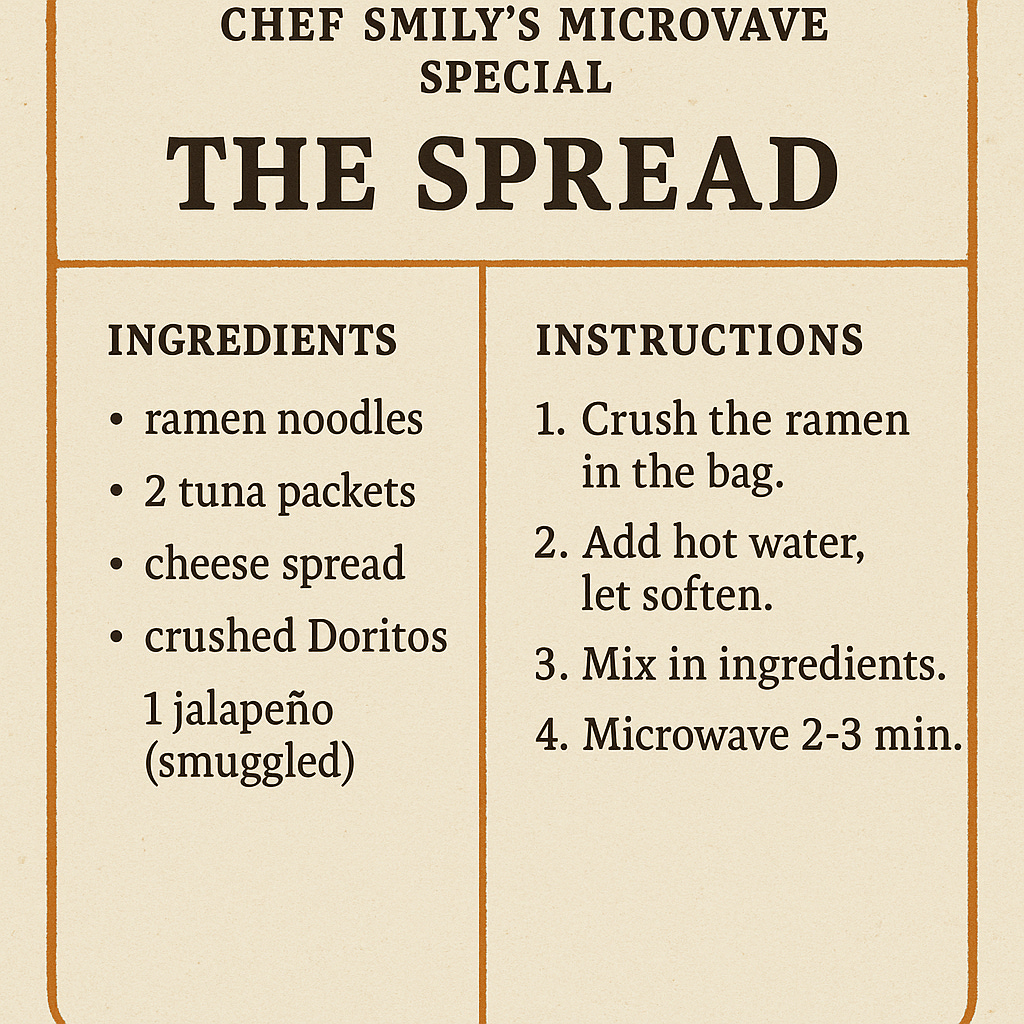
The Microwave Chef’s Weekly Special
Because where there is hunger, there is creativity.
Born of commissary ingenuity and a refusal to eat blandly, The Spread is less a recipe and more a survival ritual. This is what happens when ramen gets crushed with purpose, tuna finds companionship, and Doritos are promoted from snack to structural ingredient. Add a swipe of cheese spread for cohesion, a jalapeño for courage (acquired… creatively), and a microwave to perform the final act of culinary alchemy. Eat slowly. Share if you trust the person. And never underestimate what can be built from scraps when hunger meets imagination.


The Mayor’s Desk – Weekly Update
Official Mayor Statement:
There is no statement from the Mayor this week.
He was taken to the hole during a pod-wide shakedown, one of five inmates removed.
There is no update from the Mayor this week.
He has now been held in isolation for 16 days, locked down around the clock. There has been no write-up, no hearing, and no formal charge. The original issue was administrative and minor, a prescription bottle left visible, yet the response has been prolonged isolation.
This is how punishment often works inside: not through clear consequence, but through silence, delay, and psychological pressure. Solitary confinement is not a neutral holding pattern; it is an active force. Days blur. Sleep fractures. The mind turns inward in ways that are not always survivable.
When someone disappears into isolation without due process, the absence of information is itself a form of harm.
There is still no update.
Municipal Concerns (Grievances & Diplomacy)
The Mayor submitted a written request to the warden appealing for release from isolation, not only for himself, but for the four other men taken at the same time. As of this writing, there has been no response.
No acknowledgment.
No explanation.
No timeline.
All five men remain in isolation, held in continuous darkness, without formal write-ups or communicated cause.
The silence itself has become the grievance.
Pod Affairs Report
This week, the pod held its annual ornament-decorating contest, a low-stakes, morale-boosting craft activity that briefly transformed incarceration into something resembling a holiday.
Materials included single-ply toilet paper (and a small but controversial amount of contraband double-ply), cardboard harvested from commissary boxes, decorative pins borrowed, stolen, and found, paperclips bent into avant-garde shapes, and one severely underqualified white Christmas tree.
Within minutes, alliances formed.
Inmate R unveiled a meticulously layered snowflake made entirely of toilet paper, explaining it represented the fragility of the human spirit. Inmate D immediately accused him of plagiarism and excessive ply usage, igniting a verbal rivalry that required staff intervention, along with a reminder that this was, in fact, a holiday activity.
Meanwhile, Inmate J went rogue, constructing a three-dimensional cardboard reindeer that was both impressive and structurally unsound. When it collapsed mid-judging, he blamed jealous airflow and demanded a recount.
Decorative pins were redistributed following an incident involving hoarding. One ornament was disqualified for being “too aggressive.”
In the end, no official winner was declared, as everyone insisted the judging was rigged. The tree now leans slightly to the left, weighed down by ambition, creativity, and far too much toilet paper.
Morale: surprisingly high.
Dignity: questionable.
Holiday spirit: unmistakable.

Content note: This section contains descriptions of solitary confinement, physical restraint, and sexual humiliation. Please skip this section if that’s too much.
Meet: Sunny
Time Incarcerated: 3 years awaiting trial
Age: 46
Sunny learned early that survival meant endurance.
His childhood was marked by instability and fear, followed by a brief but formative experience of love, discipline, and belonging. That foundation mattered, because later, when everything was stripped away, it was the only thing left to hold onto.
As a teenager, anger found him before language did. He committed a serious crime rooted in misdirected rage, served time in juvenile detention, and confronted the harm he caused. That confrontation changed him. He did not want to hurt people again — especially people already struggling.
But adulthood brought losses that fractured him: the deaths of the two men who had given him safety and structure. Grief hollowed out his sense of meaning. What followed were years of political radicalization and reckless attempts to “stand with the poor” that ultimately harmed no one but himself.
He was arrested for a non-lethal attack on property. That decision would place him inside a system that, in his words, “doesn’t correct behavior, it breaks people.”
What followed was not a sentence so much as an erasure.
Sunny spent extended periods in segregated housing units — solitary confinement — where he was locked in a cell 24 hours a day. No books. No letters. No phone calls. No sheets. No mattress. Sometimes no clothing. In one facility, there was no running water. For days, the only water available came from the toilet. He drank it. He washed his face with it. He tried to rinse pepper spray burns from his skin with it.
He was restrained multiple times. In one instance, guards placed him in a forward-point restraint, his arms and legs chained above and behind him, his body stretched until his shoulders felt as if they were tearing from their sockets. He lost sensation in his hands within minutes. He was left there for six hours. He urinated on himself. When it ended, the numbness didn’t.
It never fully went away.
Transfers came without warning. Each new facility meant new hostility. He was labeled a “terrorist.” His mail was monitored. His communications restricted. His presence treated as a provocation.
In one transfer, extreme heat and infestation defined daily life. The cell had no air conditioning. Ants crawled over his body while he slept. biting his eyes, groin, and face. He woke drenched in sweat, disoriented, alone. For weeks, he did not hear another inmate’s voice.
The most difficult moments were not the beatings, but the humiliation.
Sunny describes being forced to strip in front of guards who mocked his body, used slurs, and laughed openly about rape. He was ordered to perform degrading acts under threat of violence. He complied to survive. He describes the experience not as pain, but as annihilation, the deliberate destruction of dignity.
Male sexual assault in prison is rarely spoken about. Sunny names it plainly. He witnessed it. He survived it. He carries it.
What saved him was routine.
In isolation, he built a strict daily structure: waking and sleeping at set times, cleaning his cell twice a day, exercising morning and night, counting steps in a space barely large enough to turn around. He set goals that could not be taken from him: remembering a song, writing a letter, recalling the sound of his wife’s laughter.
“If I didn’t do those things,” he says, “I felt like I failed. And failure was dangerous.”
The routine gave him something the system could not remove: agency.
Years passed this way. Then more. Eventually, he was moved to again, his trial is set. He is now waiting, not for freedom alone, but for reunion. He speaks often about seeing his family run toward him, about holding them again after years of separation.
Sunny does not deny what he did. But he rejects the idea that cruelty creates accountability.
“If we believe minor infractions deserve total destruction,” he says, “then no one grows. Not the prisoner. Not the guards. Not the society that allows it.”
He believes empathy is not weakness, it is prevention. He believes isolation destroys the mind. He believes growth is the only outcome worth pursuing.
Above all, he believes people survive because someone, somewhere, decides they are still human.
Author’s Note
Stories like this are difficult to read, and they should be. They ask us to look at what we are willing to tolerate in the name of punishment, and who we decide is worthy of dignity. Sunny shared his experience not to excuse his past, but to name what prolonged isolation, humiliation, and violence do to a human mind. If there is growth to be found anywhere in systems meant to correct rather than destroy, it begins with witnessing. Silence protects harm. Attention is where change starts.
Thank you for reading. See you in two weeks.
Next edition: December 28th
If you enjoyed reading, you can buy me a coffee ☕ — a small gesture that helps keep the creative fire burning.
If this piece spoke to you, tap the ❤️ or share it with someone who might need it too. Your quiet support keeps the ink flowing.
Girl, you did it with this one! The Buna recipe is classic! I'd love to let you pick my brain sometime if you're interested.
Rose, my goodness, Rose. This series is so important. Most people do not know the realities you depict here, like Sonny's horrific imprisonment. Thank you for sharing this.