


Disclaimer: This series is drawn from real conversations with individuals who are incarcerated while awaiting trial. All names and identifying details are changed, and some dialogue has been lightly edited for safety and clarity. These are first-hand experiences and may contain blunt or mature content. No part of these entries is fictionalized or intended to sensationalize, stereotype, or generalize. In the U.S., individuals are legally innocent until proven guilty. The purpose of this project is to provide a human-centered window into a system that is often hidden from public view.
If you missed the previous issue, you can read issue four here
Anchor Section
Short, honest answers from the men inside, shared exactly as spoken.
Q: How was your life before incarceration?
Ku:
“Good, I was working outdoors. I had freedom, family, projects, work and partying.”
Kyle:
“Lovely. It was a paradise without any legal trouble—which overtakes your life.”
Doc:
“Heartbroken. I had just lost my brother and so all I wanted to do was escape with drugs and this is where it got me.”
Q: Who influenced you most growing up?
Ku:
“Tom Brady and Batman.”
Kyle:
“My older brother, that’s why I’m here.”
Doc:
“Dad, mom, brother and the Street Fighter series.”
Q: What would you do differently if you could speak to your younger self?
Ku:
“Stay out of trouble and go into the military.”
Kyle:
“Don’t steal cars. Don’t steal at all. The adrenaline rush is addicting.”
Doc:
“Don’t be aggressive. Learn calm.”
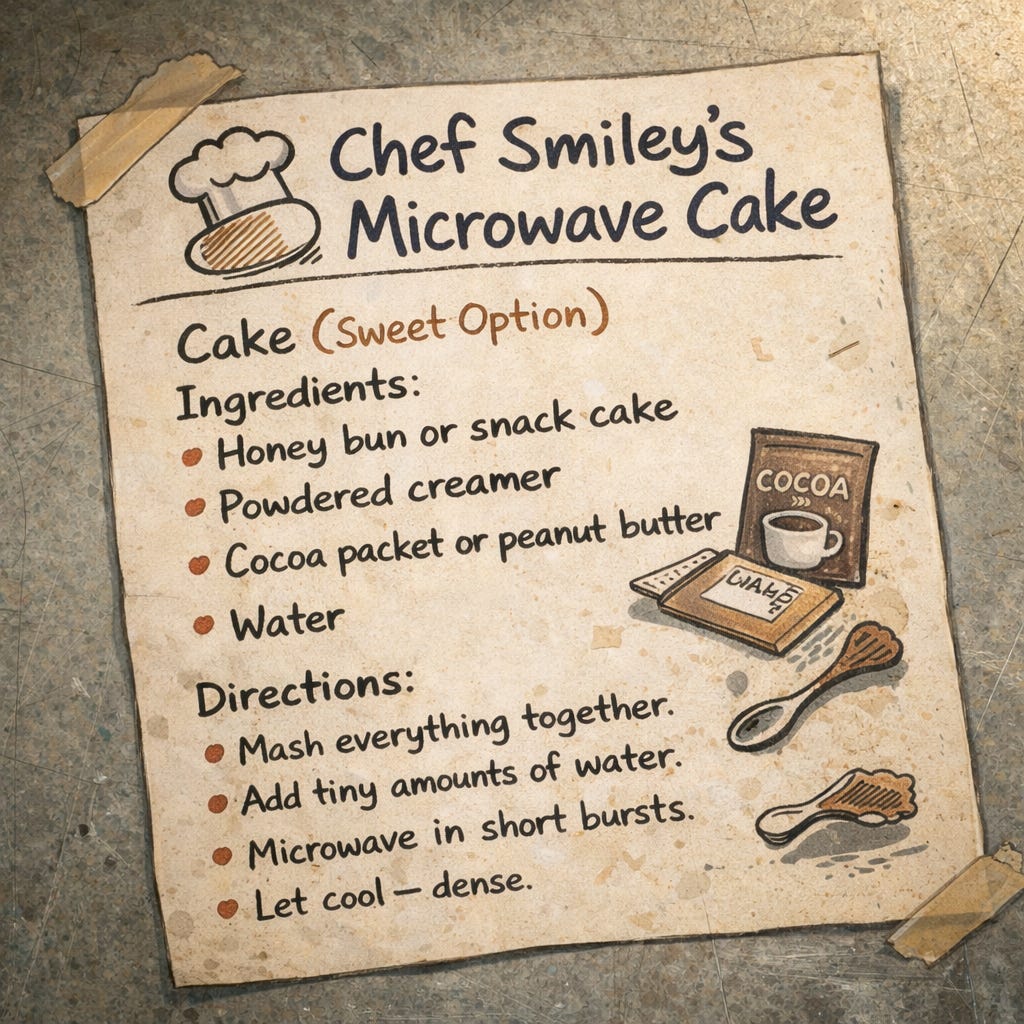
The Microwave Chef’s Weekly Special
Because where there is hunger, there is creativity.
When the kitchen is a microwave and the pantry fits in a pocket, you learn to make comfort out of almost nothing. This is food built from trade, timing, and creativity — a small act of control in a place where very little is yours.


The Mayor’s Desk – Weekly Update
Official Mayor’s Statement:
“Even if you’ve lived this before,” he said, “your body doesn’t forget what isolation does to you.”
Mayor’s Update
After spending two months in solitary confinement, the Mayor says that being allowed recreation again, even briefly, created a profound sensory shock.
The return to shared space did not feel like relief. It felt like overload.
Social deprivation had recalibrated everything. Voices sounded louder. Movement felt closer. Human presence carried more weight than he remembered.
He describes witnessing constant yelling, sudden fights, people having seizures, people attempting to hang themselves. Scenes he had once learned to mentally file away now landed with full force.
He explained that solitary confinement doesn’t make a person tougher. It strips away the filters that once helped them survive chaos. When those filters are gone, every sound, every outburst, every crisis hits raw.
At the same time, he is trying to work his way back into good standing, not only for himself, but for others around him. His hope is to be transferred to a newer facility, and to help fellow incarcerated men also be considered.
He has begun filing grievances.
Several religious books he ordered months ago never arrived. He was told they were lost, misplaced, or simply never processed. He says no clear answer has been given.
He has also raised concerns about the absence of consistent spiritual services. The chaplain is supposed to visit daily, but, according to the Mayor, rarely comes at all. When he does, it is usually only to the newer facility.
He describes this as “special treatment,” and says it leaves men in older housing units without access to prayer, counseling, or spiritual grounding.
“This isn’t about privilege,” he said. “It’s about basic human needs.”
This week, he witnessed a man coughing up blood and unable to get out of bed for days. Despite repeated requests, the facility refused to allow him to go to medical.
The Mayor says he has since written directly to the warden.
When asked how he manages to hold all of it, he paused.
“It’s just another day in paradise,” he said.
Municipal Concerns (Grievances & Diplomacy)
In addition to the grievances already filed, the Mayor says he is still working to secure consistent access to regular mail.
He describes mail as more than correspondence. It is a lifeline. A reminder that the outside world still exists, and that people still exist in relation to him.
Much of his daily work, however, happens on a quieter, informal level.
He often finds himself mediating disputes over commissary and store orders. Coffee, in particular, has become its own form of currency.
Men will borrow coffee with agreements to pay it back once their next order arrives. When that order comes and repayment does not, tensions escalate quickly.
Small debts become big conflicts.
The Mayor says he steps in before those moments turn physical.
It requires constant negotiation between individuals and, at times, between members of different gangs. Compromises are proposed. Terms are restated. Cooling-off periods are encouraged.
“It’s not about taking sides,” he said. “It’s about keeping people alive.”
He describes this role as exhausting, but necessary.
Inside a system built on punishment, informal diplomacy becomes one of the few tools available to prevent further harm.
Most days, the work goes unnoticed.
But when it works, a fight does not happen.
And in this environment, that matters.

Meet: Sol
He tells me he never wanted to fight. Not when he was a kid. Not when everything first started going wrong. He says he was quiet back then — the kind of quiet that isn’t mysterious or brooding, just careful. A boy who kept his head down, who tried not to take up too much space, who minded his business, who said “yes, sir,” who did what he was told. In his neighborhood, that kind of boy doesn’t get left alone. It makes you visible in the worst way.
By the time he was twelve, the bullying had stopped being jokes and shoves in hallways. It had hands. It had weight. It had intention. One night, a group of older boys started chasing him through a park, and he remembers how fast his brain worked, how fear turns seconds into calculations. He could sprint toward the highway, try to cross lanes of speeding cars to reach a police station on the other side. Or he could cut through the dark toward the far edge of the park, where a rival gang claimed territory. He knew something important: the boys chasing him wouldn’t cross that line. So he ran. He didn’t make it. They caught him before he reached anything that looked like safety.
Six of them. Chains, sticks, fists, boots. He doesn’t describe it like a story. There’s no flourish, no drama. Just fragments. Pain in flashes. The sound of someone laughing. The taste of dirt. The shock of realizing how small a body can feel when it’s surrounded. What stopped it wasn’t police or strangers. It was the rival gang. Men built like tanks. Grown men with reputations that carried weight in the neighborhood. They pulled him off the ground, stood between him and the boys who had been hurting him, then walked him home, not in front of him, not behind him, but beside him, close enough that anyone watching understood he wasn’t alone. He tells me that was the first time in his life he remembers feeling protected. Not comforted. Not safe in a soft way. Shielded. For the first time, he felt what power felt like.
At thirteen, he was jumped into the gang. He doesn’t talk about it like a celebration. He talks about it like a doorway he didn’t realize only swung one way. The gang gave him somewhere to put feelings he had never learned to name — rage, grief, humiliation, fear. It also gave him structure. Rules. A hierarchy. A code. The worst thing you could be was a coward. Respect belonged to the loudest, toughest, most aggressive. So he tried to become that person. Not because it fit who he was, but because it felt like the only version of himself that might survive.
Not long after he joined, an older man put a gun in his hand, not with ceremony or warning, just a matter-of-fact explanation of when to use it and who against. By fourteen, he and other boys had stolen a small rifle and cut it down using household tools. He remembers how ordinary that part felt, like a craft project, like kids messing with something they didn’t understand the weight of. Soon after, they tried to rob a man on the street. He remembers the sound of his own voice shaking when he told the man to empty his pockets. He remembers pointing the gun. He remembers the man slapping the barrel away. And then he remembers something inside him breaking — not exploding, not screaming, just breaking. Years of being invisible, years of being scared, years of swallowing everything rushed forward at once. He pulled the trigger. A man died.
He says what came after wasn’t like the movies. No slow motion. No soundtrack. No instant regret speech. Just emptiness. A hollow space where something used to live. He was arrested not long after. Nearly six years followed — jails, detention centers, release, rearrest, over and over. A rhythm formed: violence, loss, grief, more weight added to a life that already felt unbearable.
Inside, he started reading. At first just to pass time, then with intention. Malcolm X. Dictionaries. Religious texts. Anything that suggested a human being could become more than the worst thing they’d ever done. He became obsessed with the idea of transformation, with the belief that a person could discipline themselves into becoming someone new, that knowledge could rewire a soul. But the books didn’t make the anger disappear.
Jail is racially segregated. Tension never shuts off. You sleep alert, eat alert, breathe alert. Every interaction is a calculation. One argument turned into many people shouting. He didn’t hit anyone, but someone else stabbed the man. He was still held responsible. He was sent to solitary confinement. Twenty-three hours a day in a cell, sometimes weeks without leaving it. He says the silence was louder than the yard. The isolation bent his mind. He started talking to himself, reliving everything, rewriting nothing. That’s when he realized he needed a way out that didn’t involve running.
He found a book about doing time on the inside. It talked about breathing, stillness, meditation. At first, he used meditation to make mental lists — lists of people who ruined his life: parents, police, teachers, the system, God. The lists were long. They felt righteous. After weeks, they stopped growing. One day, his own name appeared. He didn’t want to write it. He fought it. Then he wrote it anyway. He tells me that was the first honest thing he’d done in years. If everything on those lists was true, he had to ask what his part was. He was the common denominator.
He began to see himself not as a monster, not as a victim, but as a grown man still using the emotional tools of a fourteen-year-old boy, a boy who never learned how to sit with fear, who never learned how to ask for help, who learned early that rage got results. Rage had become his only language.
Later, he joined a restorative justice program. Victims and offenders sat in circles. No yelling. No posturing. People talked about what violence took from them, sleep, families, trust, safety, future versions of themselves. He learned words for emotions he had always felt but never had language for. Shame. Remorse. Longing. Grief. He watched people disagree without swinging. It shocked him. It quietly rewired his idea of strength.
Today, he doesn’t say he’s healed. He says he’s practicing. He wants to start a business when he gets out. He wants to write. He wants to tell stories that interrupt the road he walked. When I ask him who he is beneath the charges, beneath the labels, beneath the history, he doesn’t hesitate: “I’m a human being. I was a little boy who wanted to be loved. I’m a man who wants peace.”
He doesn’t believe peace is handed out by courts or systems. He believes peace is something you build — slowly, internally, every day.
Author’s Note:
Holding space for someone’s humanity does not mean denying the harm they caused. Both can exist at once. This piece is an exploration of that tension and of what it can look like when a person chooses to practice change, even inside a system not built for healing.
Thank you for reading.
Next edition: March 8th
If you enjoyed reading, you can buy me a coffee ☕ — a small gesture that helps keep the creative fire burning.
If this piece spoke to you, tap the ❤️ or share it with someone who might need it too. Your quiet support keeps the ink flowing.
Well written! I agree, holding space for humanity and accepting the harm they caused can exist at the same time. Thanks for sharing this!